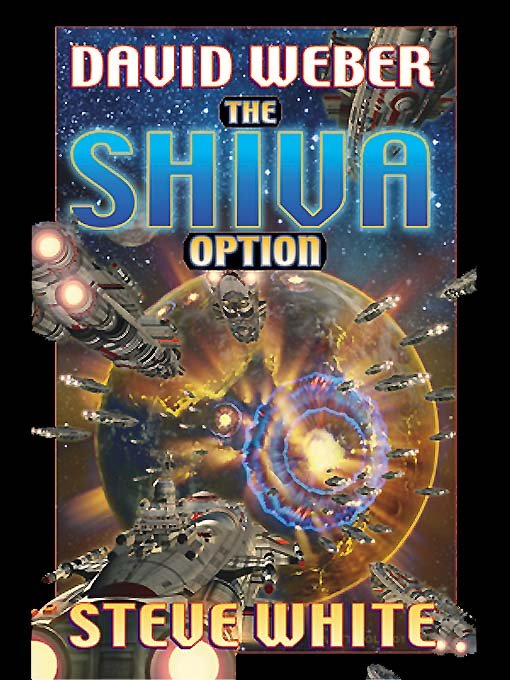
I look at The Shiva Option by David Weber and Steve White, the fourth Starfire book and the sequel to In Death Ground, where the Grand Alliance stops trying to win a war against the Bugs and starts trying to wipe them out, one home hive at a time.
I enjoyed it a lot, mostly because it plays like a giant game of Master of Orion written up as a novel. The fleet battles are huge and really well done, but the characters are thin, and I can see a lot of readers bouncing off it for exactly the reasons I liked it.
Hopefully you’ve had the joyous pleasure of playing the old PC space strategy game Master of Orion and its successors, otherwise known as MOO I to MOO III. If not, you’re really missing out on something enjoyable, and in a similar fashion to Civilization (and its successors) it’s a game that truly makes you experience the agony of “just one more turn” syndrome, where you look up and it’s two in the morning and you’ve only meant to finish one invasion for the last three hours. The original came out in 1993 and Master of Orion II: Battle at Antares followed in 1996, and they’re still the games a lot of people measure every space strategy game against.
If you’ve enjoyed those games, you’ll find that The Shiva Option brings back some extremely fond memories. The whole space combat experience, and the inclusion of races like the Terrans and the Orions, is very similar to what you get in that game, and reading it felt a lot like watching somebody else play a really long campaign. It’s a very different kind of David Weber book from On Basilisk Station, co-written with Steve White and built around whole fleets rather than one captain and her ship. Now, while there are some (many) similarities to Master of Orion, The Shiva Option is actually based on another game entirely, a tabletop space wargame called Starfire, which was a surprise to me. Starfire started out as a tabletop game from Task Force Games back in 1979, all hex maps and ship record sheets, and once you know that, the way the book plays out makes a lot more sense.
The Starfire series and a war nobody can talk their way out of
The Shiva Option is the fourth Starfire book and a direct sequel to In Death Ground, by the same writing team, so you really do want to have read that one first. At the end of In Death Ground the Grand Alliance of Terrans, Orions, Gorm and Ophiuchi has taken a catastrophic beating at the hands of the Bugs. Many senior commanders are gone, along with the bulk of the Terran Federation’s pre-war fleet, and it’s in that perilous universe that this book picks up, with the Alliance rebuilding and trying to work out how to stop losing.
The thing about the Bugs is that you can’t talk to them. There’s no diplomacy, no surrender and no peace treaty, because the Bugs don’t see other species as anything but food, and every world they take ends up as a farm. So the Alliance comes to the conclusion that this has become a fight for the survival of their species, and for the first time since their old war with the Rigelians they invoke the directive that comes to be known as the Shiva Option, after the Hindu god of destruction. It means exactly what it sounds like. They’re no longer trying to beat the Bugs, they’re trying to exterminate them, starting with the home hives. That’s a heavy idea to hang a book on, and it’s the same kind of no-way-out alien war you get in Old Man’s War, except here it’s the humans and their allies who decide to go all the way.
Now I am become death, the destroyer of worlds.
The Bhagavad Gita, famously quoted by J. Robert Oppenheimer after watching the first atomic bomb test.
Finding the hives, one campaign at a time

The story progresses in a fairly standard pattern. Members of the Alliance stumble across one of the five Bug home hives, build up an overwhelming force of ships and personnel, and then head off to destroy it. The Bugs throw everything they have at the defence, and just when it looks like they might win, the humans (or, less often, the Orions) come up with something that turns the tables and lets them carry out the Shiva Option. Then you do it again with the next one. If that sounds a bit like a campaign in a strategy game, that’s because it is, and that’s a big part of why I enjoyed it as much as I did.
But I’ll be honest, that same thing is quite likely to turn someone else off, because this book very much reads like a military history, an account of hundreds of different small-scale campaigns over the course of the war against the Bugs. There is some character growth and development, but most of the main characters, the admirals, are written as almost “forces of nature”, and while the storyline with the pilot is good, it’s too limited to really grab you. The reviewer at Publishers Weekly said space opera fans won’t be disappointed, and I think that’s right, as long as you know you’re signing up for the fleet battles first and the people second.
Surprisingly, the “thoughts” of the Bugs are quite possibly the most interesting part of the book. Their reactions in some situations are frustratingly slow, which is annoying when you can see the Alliance coming and they can’t, but “listening” to what they’re planning and then seeing how the Alliance responds is really cool. It gives you two sides of the board to watch, which is exactly what you’d want if you were watching a game.
Battles I’d love to have played, crews I never met
The actual battles and campaigns are really well written and interesting. Weber and White know how to lay out a fleet engagement so you can follow who’s where and why it matters, and when the big set pieces kick off they’re properly exciting. But after a while the count of ships damaged and destroyed starts to pale, because there’s no one on those ships that we actually care about, or even know for that matter! Losing forty ships should hurt, and on the page it mostly reads like a number going down.
A lot of the fighting happens around warp points, the fixed jump points that link one star system to the next in the Starfire universe, so every assault through one is a bottleneck. You can’t go around, you have to push through the choke point into whatever’s sitting on the other side, mines, fortresses, a wall of Bug ships, and the book gets a lot of tension out of that. Anyone who’s played a space strategy game will recognise the feeling of staring at one narrow route into an enemy system and knowing it’s going to cost you, and the authors clearly know that feeling too.
And yet, if this was a game that had been played out and then written up, which is honestly what it feels like at times, I’d have loved to see it, because the fleet sizes in some of these battles are truly awe-inspiring. Hundreds of ships, fighter strikes, whole systems turned into battlefields. This is the scale you always wanted in Master of Orion and never quite got, and for a game player that’s a real treat.
The Star Union of Crucis changes the stakes
The part of the book that worked best for me comes once the Star Union of Crucis joins up with the Grand Alliance. They’re a multi-species nation that fought the Bugs more than a century earlier and has been hiding and rebuilding ever since, and their decision to take the fight to the Bugs on the worlds the Bugs have colonised finally brings some sense of reality and scope to the story. It’s a big book, close to 700 pages in hardcover, and by the time the Star Union are in the thick of it you’ve been through a lot of campaigns, so their arrival gives the story the jolt it needs. Up to then it’s been fleets against fleets. Now it’s about the people the Bugs have actually been eating, and the Star Union have cousins on those planets.
It’s probably not realistic for a spacefaring civilisation to become a non-intelligent food source in only one or two generations, but the care the members of the Star Union show for their cousins is very well portrayed, and it gives the last stretch of the book something the earlier campaigns don’t have, a reason to care about who’s on the ground and not just who’s in orbit. A fun bit of trivia: the Star Union started life as a setting designed for the Starfire game itself by a player called Fred Burton, and the authors thank him for letting them borrow it, which makes the whole game connection even neater.
Was the Alliance right to go for the Shiva Option, or should they have kept looking for a way to talk to the Bugs, however hopeless it seemed? Tell me in the comments.

6 comments
[…] does this to some extent, the ones previously that I thought most outstanding in this area was the Shiva Option by David Weber & Steve White (reviewed here). However, I think they there is a new contender to this crown now in Warlords Invasion & if […]
[…] in a military sci-fi series that handles the same problem more gracefully, On Basilisk Station and The Shiva Option are the Weber comparisons I keep reaching for. My original Troy Rising trilogy write-up from 2015 […]
[…] a princess the Pale Ones turned into a superweapon. And if you want to see where my head was at, The Shiva Option is the book that gave me the Master of Orion itch I’m always trying to […]
[…] read the final tallies of the damage at the end. This is a fault with Weber in his series the Shiva Option although in that book its done quite well and also Saxon in the Escape to Earth Series where its […]
The Bugs in this series always put me in mind of the Arachnids in Starship Troopers, another enemy you can’t negotiate with and that just keeps coming, and it’s interesting how differently the two stories handle it. Heinlein is mostly interested in the soldiers and what the war makes of them, while Weber and White are interested in the fleets and the arithmetic, which is exactly why this one scratches the Master of Orion itch so well.
[…] belongs to an alien race that keeps humans the way we keep cattle. I’d just come off a run of aliens who see other species as food in Starfire, but this is a much more up close and personal version of that idea, with swords and […]