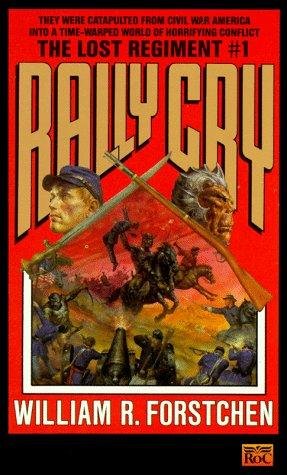
I look at Rally Cry, the first book in William R. Forstchen’s Lost Regiment series, where a Union regiment from the Civil War gets pulled through a tunnel of light onto Valdennia, a world where medieval Russians live under the shadow of the Tugar Horde, nine-foot nomads who treat humans as livestock.
I thought it was a really well thought out first book and a page turner from start to finish. The characters work even if the Maine boys are a bit too squeaky clean, and the crash industrial revolution only makes sense because nobody wants to be eaten. I gave it 5/5 for characters, 4/5 for story and 9/10 overall.
Rally Cry is the first novel in William R. Forstchen’s Lost Regiment series, and it’s one of those books where the hook is so good you can’t believe nobody did it before. Take a Union regiment out of the American Civil War, drop it on another planet full of people who were snatched from Earth centuries earlier, and then show you what’s really running the place. Forstchen’s a Civil War historian and you can tell, because the soldiers talk, march and fight like men who’ve been through Antietam and Gettysburg, not like action heroes in blue coats. The book came out from Roc back in 1990 and I’d been meaning to pick it up for a while, and once I did I didn’t put it down much.
The setup goes like this. The 35th Maine, along with a battery from the 44th New York Light Artillery, are on a transport ship heading to the next fight against the Confederacy when a storm hits and a “tunnel of light” swallows the lot of them. They wake up somewhere that very clearly isn’t Virginia. It’s Valdennia, and the more they learn about it the worse it gets, because the planet belongs to an alien race that keeps humans the way we keep cattle. I’d just come off a run of aliens who see other species as food in Starfire, but this is a much more up close and personal version of that idea, with swords and horses instead of starships.
The 35th Maine Lands on Valdennia
What the regiment finds when it gets its bearings is a jumble of human civilizations from different periods of Earth’s history, all dumped on the same world and all stuck at whatever level they arrived with, a bit like the exiles left to fend for themselves on Treason but with a lot more history mixed in. The Maine men come ashore close to a Russian city called Suzdal in the land of Rus, and it’s like stepping back into the middle ages, onion domes, peasants, priests and a ruling class that has things very much its own way. Colonel Andrew Keane has to work out fast where his men fit in, because they’ve got a few hundred rifles, some cannon and no way home, and nobody here has ever seen anything like them.
The local chieftain, Ivor, is “happy” with the status quo, which is to say he’s happy because he’s on top of it and the peasants underneath him aren’t. He’s not keen on a bunch of armed strangers turning up with odd ideas. And the ideas are the thing, because the 35th Maine have just spent years fighting a war about freedom and democracy and they don’t stop believing in that just because they’re on a different planet. Bit by bit those ideals start to spread through the peasant population around Suzdal. I really enjoyed this part, it’s political and slow burning, and you can see the trouble coming for Ivor a long time before he does.
There’s also a nice touch where the soldiers have to figure out the language and the church and the whole social order before they can do anything useful, so it’s not just a case of Yankees marching in and fixing everything. Keane has to keep his own men in line too, some of whom would rather just take what they want, and he has to deal with the local church, which isn’t exactly thrilled about outsiders either. It all feels very believable for a bunch of farm boys and lumbermen from Maine who suddenly find themselves the most advanced army on the planet.
The Tugar Horde
And then there’s the real ruler of Valdennia, a malevolent civilization that sits above all the human ones. This is the Horde. Based on the Mongols, the Horde are nine-feet-tall alien nomads who ride enormous horses and circle the planet, using the transported humans as slaves and food stock. When they come through a land they devour one fifth of the population and then move on to the next one, and it’s into the middle of that arrangement that the 35th Maine find themselves thrust. There are actually different “hordes” spread around the planet and book 1 deals with the Tugars, who are the ones due to come through Rus next.
Once the regiment learns what’s coming they’ve got a choice to make, and they decide to stay and fight it out alongside the Russian peasants who’ve revolted against Ivor and his regime. The odds are terrible. The Tugars massively outnumber the humans in terms of warriors and every one of them is huge, but the 35th Maine and the 44th New York have firepower, modern weapons and modern tactics on their side, and the Tugars want nothing to do with guns. Other fans of the Lost Regiment rate the battles as the big selling point of the whole series and I can see why, because Forstchen knows exactly how a line of rifles and a battery of guns would hold up against a cavalry charge.
What makes the Horde work for me is that they aren’t just monsters. They’ve got their own culture and their own pride and they honestly can’t understand why the cattle would suddenly fight back. That gives the whole thing a much darker edge than a straight alien invasion story, because the humans on Valdennia have lived with this for generations and most of them accept it as just the way the world is. The idea of a fallen civilization using humans for cattle was completely new to me, and it’s a creepy one that stuck with me well after I finished.
A Railroad Built Against the Clock

Realizing the Horde will be on them in a very short time, the Lost Regiment basically drags Rus society into the industrial age overnight. With the Tugars coming there’s very little dissent about it, and factories and a railroad are built and put into operation at a speed that would make any real Victorian engineer weep. It reminded me a bit of the rebuild in Lucifer’s Hammer, where the survivors who still remember how things work suddenly matter more than anyone else, except here it’s mill workers and mechanics from Maine teaching peasants to cast cannon and lay track.
I liked the detail in all of this. You get the practical problems, where the iron comes from, how you make powder, how you train men who’ve never held a rifle, and the sense that every single day matters because the Horde isn’t going to wait. It’s also where the politics with Ivor and the church come to a head, since you can’t build a modern army out of serfs and keep them as serfs at the same time. Forstchen keeps all of it moving though, it never turns into a manual on blacksmithing.
Then the Tugars arrive and a furious battle breaks out. The men of the Lost Regiment and their Rus allies are almost overwhelmed, and for a while it really does look like the whole thing has been for nothing, before one of the Americans blows up the dam and the flood wipes out a huge chunk of the Horde. Forced to sue for peace, the Tugars leave and ride away a shadow of their former selves. It’s a great finale and it’s set up for a lot more, because the Tugars were only one horde out of several.
My Thoughts on Rally Cry
A really well thought out 1st book and a definite page turner. It’ll keep you gripped from beginning to end, and I really liked this book, its overall characterizations as well as the writing, and I’d definitely recommend it. If you like military SciFi with a historical bent, or you’ve ever wondered how a Civil War regiment would do against something genuinely alien, this is about as good as it gets.
The key characters in the series are all believable, and while the despotic Russian leader might be a bit formulaic, you can’t argue with history! The members of the 35th Maine are perhaps a bit too “red, white and blue”, all the best of America with none of them showing the foibles you’d expect from a regiment of real soldiers. Being that it was a “simpler” time and they were in the middle of their own Civil War though, that can be excused, since anyone not thinking the same thoughts was probably on the other side anyways! The story is really good and gripping, my only real gripe being the advancements the regiment manages to make, which are perhaps only really believable if you take into account the added pressure of being eaten! Union Forever is next in the series and I’ll be picking it up.
Character Growth & Development – 5/5
Story Growth & Development – 4/5
Overall Rating – 9/10
If you’d been Keane, would you have stayed and fought the Tugars with the peasants of Rus, or tried to keep your head down and wait for a way home? Tell me in the comments.

1 comment
The more I think about it, the more the 35th Maine’s situation feels like Mark Twain’s A Connecticut Yankee in King Arthur’s Court, modern know-how dragging a medieval society forward, except Forstchen gives you a whole regiment and an enemy that’s going to eat you if it doesn’t work. Taylor Anderson’s Destroyermen does something similar with a WWII destroyer crew lost on another Earth, and the two would sit nicely side by side on a shelf for anyone who likes history crashing into SciFi.